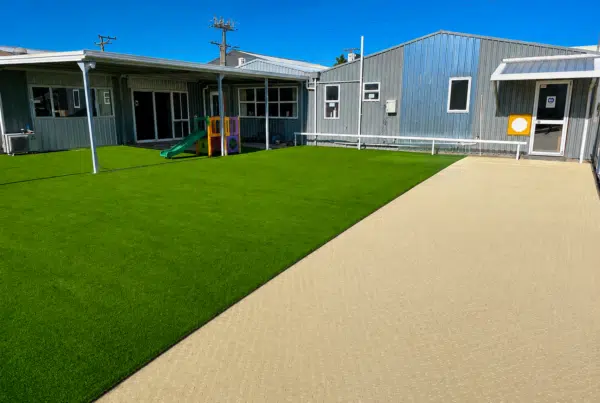
Shock absorbing turf is designed to help create an impact-attenuating surface beneath playground equipment where fall-height protection is required.
But the artificial grass you see on the surface is only one part of the system.
For a playground surface to provide documented impact protection, the artificial turf, shockpad, infill and tested configuration need to work together. The required performance also depends on the free height of fall of the playground equipment.
Understanding how these components work together makes it easier to specify the right playground surface rather than simply choosing artificial grass that feels soft underfoot.
What Is Shock Absorbing Turf?
The term shock absorbing turf generally describes an artificial turf system designed to reduce impact forces when someone falls onto the surface.
In playground applications, this is commonly achieved by installing artificial turf over a purpose-designed shockpad.
The shockpad provides an impact-attenuating layer beneath the turf, while the complete installed system creates the finished playground surface.
However, adding a shockpad beneath artificial grass does not automatically mean the surface provides a particular level of fall protection.
The important factor is the tested performance of the complete surface configuration.
How Does a Playground Shockpad Work?
A playground shockpad is installed beneath the artificial turf to help absorb and dissipate energy during an impact.
When someone falls onto the surface, the shockpad compresses under load. Its structure helps reduce the impact forces transmitted through the surface compared with a harder construction.
The performance of the finished surface can be influenced by several components, including:
- artificial turf specification
- shockpad type
- shockpad thickness
- infill type and quantity
- the complete tested surface configuration.
This is why playground impact protection should not be judged simply by pressing on the grass or deciding whether a surface feels soft.
What matters is its documented impact performance.
Impact Protection Is a Complete System
Artificial Turf
Creates the finished playground surface and forms part of the tested configuration.
Shockpad
Provides the impact-attenuating layer beneath the artificial turf.
Infill
Forms part of the tested configuration where specified.
Certified Performance
The complete configuration is tested to establish its Critical Fall Height.
Critical Fall Height and Shock Absorbing Turf
Critical Fall Height (CFH) is used to describe the impact-attenuating performance of playground surfacing.
When playground equipment requires impact-attenuating surfacing, the certified performance of the surface needs to be appropriate for the equipment’s free height of fall.
For example, a surface system certified to a Critical Fall Height of 1.5 metres should not be treated as suitable for equipment requiring impact protection at a greater fall height.
Different playground equipment can therefore require different surfacing performance.
The objective is not simply to install the thickest shockpad available. It is to specify a tested surface system appropriate for the actual playground equipment and application.
Current PlaySafe guidance states that the surfacing system’s certified CFH needs to be equal to or greater than the equipment’s free height of fall.
The Turf and Shockpad Must Be Tested as a System
This is one of the most important points when comparing playground turf systems.
A certification for a shockpad should not automatically be interpreted as certification for every artificial turf installed over that shockpad.
Likewise, changing the artificial turf, shockpad thickness, infill or another component can change the performance of the finished system.
Where certified impact attenuation is required, certification should relate to the specific surface configuration being proposed.
PlaySafe’s current guidance reinforces this point: certification applies to the tested surfacing system rather than simply the visible top layer, and changing components can alter performance.
Check the Tested Configuration
✓ Artificial turf specification
✓ Shockpad type and thickness
✓ Infill specification where applicable
✓ Certified Critical Fall Height
✓ Current independent certification
Unreal Lawns has independently tested artificial turf and SafeBase shockpad configurations for different Critical Fall Height requirements.
Does Thicker Shockpad Mean Better Fall Protection?
Not necessarily.
Shockpad thickness can influence impact performance, but thickness alone does not establish the Critical Fall Height of an installed playground surface.
Different combinations of turf, shockpad and infill can perform differently.
This is why selecting playground surfacing solely by comparing statements such as 30 mm shockpad or 50 mm shockpad can be misleading.
The more useful question is:
What Critical Fall Height has this particular turf and shockpad configuration actually been tested and certified to provide?
That allows the surface specification to be matched to the playground equipment rather than relying on assumptions about individual components.
Artificial Turf Is Not Automatically Fall Protection
Artificial turf can provide a durable surface for many playground environments, but artificial grass itself should not automatically be described as certified fall protection.
There is also an important distinction between general playground turf and impact-attenuating playground turf systems.
Artificial grass can be used in general recreation areas, pathways, seating areas, landscape zones and other parts of a playground where certified impact attenuation may not be required.
Where playground equipment creates a fall-height requirement, an appropriate tested impact-attenuating system can then be specified beneath and around that equipment.
This allows the playground surface to be designed according to the requirements of each area rather than assuming every square metre needs the same construction.
What Happens Beneath the Shockpad?
Impact attenuation is only one part of playground turf construction.
The shockpad and artificial turf still require a stable base beneath them.
Depending on the site, professional base preparation can include excavation, geotextile where appropriate, compacted aggregate layers, drainage consideration and accurate finished levels.
A poorly constructed base can develop movement, low areas or drainage problems regardless of the quality of the turf and shockpad installed above it.
For this reason, Unreal Lawns treats the base, shockpad and artificial turf as parts of a complete playground surfacing system rather than unrelated products.
Shock Absorbing Turf and NZ Playground Requirements
NZS 5828:2015 is the primary New Zealand standard covering playground equipment and surfacing.
PlaySafe’s current guidance explains that equipment with a free height of fall greater than 600 mm generally requires impact-attenuating surfacing beneath and around the equipment. Some forced-movement equipment, such as swings, may require impact-attenuating surfacing regardless of fall height.
Where impact-attenuating surfacing is required, the selected surface needs documented performance appropriate to the equipment’s free height of fall.
Impact testing is used to establish the Critical Fall Height performance of playground surfacing. PlaySafe’s certified surface register records products tested in accordance with NZS 5828:2015 / EN 1177 and their verified CFH ratings.
For a broader explanation of playground safety, fall-height considerations and surface selection, see our separate guide:
How to Check a Shock Absorbing Turf System
Before specifying a playground turf system for an area requiring impact attenuation, ask for evidence covering the actual system being proposed.
Check:
✓ What artificial turf was tested?
✓ What shockpad was tested?
✓ What shockpad thickness was used?
✓ What infill was included?
✓ What Critical Fall Height was achieved?
✓ Is the certification current?
✓ Can the certification be independently verified?
PlaySafe maintains a public Certified Playground Surface Register, allowing playground owners, specifiers and project teams to check certification information for tested playground surfacing products.

Choosing the Right System for a Playground Project
There is no single shock absorbing turf configuration that is automatically right for every playground.
The appropriate system depends on the playground equipment, required impact performance, site conditions, drainage, intended use and overall project design.
That is why Unreal Lawns offers different certified SafeBase configurations rather than treating one shockpad construction as the answer to every project.
For commercial projects, we can help determine which artificial turf and shockpad system is appropriate for the playground design and required Critical Fall Height.
Shock Absorbing Turf FAQs
Does artificial turf absorb impact on its own?
Artificial turf should not automatically be treated as certified impact protection. Where Critical Fall Height protection is required, the performance needs to be based on the complete tested surface configuration.
What goes underneath artificial turf to provide impact attenuation?
Where impact attenuation is required, artificial turf can be installed over a purpose-designed playground shockpad. The complete system may include the turf, shockpad and specified infill over a professionally constructed base.
Does a thicker shockpad always provide a higher Critical Fall Height?
Not automatically. Shockpad thickness is only one part of the system. Critical Fall Height should be established from testing of the particular turf, shockpad and infill configuration rather than assumed from thickness alone.
How do I know what Critical Fall Height my playground needs?
The required surface performance depends on the playground equipment and its free height of fall. Where impact-attenuating surfacing is required, the certified CFH of the surface needs to be appropriate for that equipment.
About the Author: Paul Gardner
Founder & NZ Turf Specialist at Unreal Lawns
Paul Gardner has spent years developing his knowledge of synthetic turf technology, including travelling internationally to study manufacturing, yarn engineering and playground safety systems. His experience helps shape the artificial grass and playground surfacing systems Unreal Lawns provides for New Zealand conditions.
Planning a Playground Turf Project?
Need help selecting an artificial turf and shockpad system for a playground project?
Unreal Lawns supplies and installs commercial playground turf systems across New Zealand, with independently tested SafeBase configurations available for different Critical Fall Height requirements.