
Artificial Grass vs Bark for Childcare Centres
Choosing the right playground surface is one of the most important decisions for any childcare centre. It affects children’s safety, daily maintenance, cleanliness, drainage and how often outdoor play areas can be used throughout the year.
For decades, bark has been the traditional playground surface beneath play equipment because it provides impact absorption at a relatively low installation cost. More recently, artificial grass installed over certified shockpad systems such as the SafeBase Certified Shockpad System has become an increasingly popular alternative, offering a cleaner, lower-maintenance solution while still providing certified impact protection where required.
Both playground surfaces have advantages, but they perform very differently in busy childcare environments. Factors such as ongoing maintenance, drainage, hygiene, durability, long-term costs and Critical Fall Height (CFH) requirements all play an important role when deciding which option is right for your centre.
This guide compares artificial grass and bark side by side, helping childcare providers understand the strengths and limitations of each playground surface so they can make an informed decision for their outdoor learning environment.
Artificial Grass vs Bark Comparison
| Feature | Artificial Grass | Bark |
|---|---|---|
| Safety | ★★★★★ | ★★★★☆ |
| Maintenance | ★★★★★ | ★★☆☆☆ |
| Drainage | ★★★★★ | ★★★☆☆ |
| Cleanliness | ★★★★★ | ★★☆☆☆ |
| Appearance | ★★★★★ | ★★★☆☆ |
| Durability | ★★★★★ | ★★★☆☆ |
| Year-Round Use | ★★★★★ Always available | ★★★☆☆ Weather dependent |
| Long-Term Value | ★★★★★ | ★★★☆☆ |
While both surfaces have their place, the best choice depends on how your childcare centre operates. Centres with heavy daily foot traffic often prioritise cleanliness, low maintenance and year-round usability, while others may place greater emphasis on minimising upfront costs. Understanding how each surface performs in real-world childcare environments makes it much easier to choose the right solution.
Which Surface Wins?
Both bark and artificial grass can provide safe playground surfacing when installed correctly and used in the appropriate areas. Bark remains a practical option for some playgrounds, particularly where lower upfront costs are a priority. However, many childcare centres are now choosing artificial grass because it creates cleaner outdoor spaces, reduces ongoing maintenance, improves drainage and provides a natural-looking surface that remains attractive throughout the year. When combined with the SafeBase Certified Shockpad System, artificial grass can also provide independently tested Critical Fall Height protection for qualifying playground equipment, making it a premium solution for modern childcare environments.
What Is Bark Playground Surfacing?
Bark has been used as playground surfacing in childcare centres, schools and public playgrounds for many years. It is commonly installed beneath playground equipment because it can provide impact absorption when installed at the correct depth and maintained in accordance with playground safety requirements.
Many childcare centres choose bark because of its relatively low upfront installation cost and natural appearance. It has traditionally been one of the most common playground surfacing options beneath climbing equipment, swings and play structures.
However, bark is an organic material that gradually breaks down over time. Daily foot traffic, weather and children’s play can cause it to shift away from high-impact areas, reducing its depth and requiring regular maintenance to maintain both appearance and safety.
For busy childcare centres, ongoing maintenance is often one of bark’s biggest challenges. Regular raking, topping up and replacement are needed to help maintain a safe, clean and compliant playground environment.

Advantages of Bark
Bark continues to be a suitable playground surface for many childcare centres because it offers several benefits:
- Natural appearance that blends well with outdoor environments.
- Lower upfront installation cost than many alternative playground surfaces.
- Provides impact absorption when installed and maintained correctly.
- Commonly used beneath playground equipment.
- Easy to install in many playground layouts.
- Suitable for areas where a natural-looking playground surface is preferred.
Disadvantages of Bark
While bark has been widely used for many years, it also has several limitations that become more noticeable in busy childcare environments.
- Requires regular raking to maintain an even depth.
- Needs continual topping up as bark naturally breaks down.
- Can be displaced during children’s play, exposing the base beneath.
- Frequently tracks into classrooms on children’s shoes.
- Can become untidy after strong winds or heavy rain.
- Requires ongoing maintenance to help maintain playground safety requirements.
- Can harbour leaves and organic debris if not regularly maintained.
- May need replacing periodically as the material decomposes.
Where Bark Works Best
Bark is generally best suited beneath playground equipment where impact attenuation is required and where staff can commit to regular inspection and maintenance. It can be an effective playground surfacing solution for centres with lower daily use or where keeping initial installation costs down is the primary consideration.
For larger childcare centres with heavy daily foot traffic, maintaining bark can become increasingly time-consuming. As a result, many providers are now exploring alternative playground surfacing options that offer similar safety benefits while reducing ongoing maintenance and improving the cleanliness of outdoor learning environments.

What Is Artificial Grass Playground Surfacing?
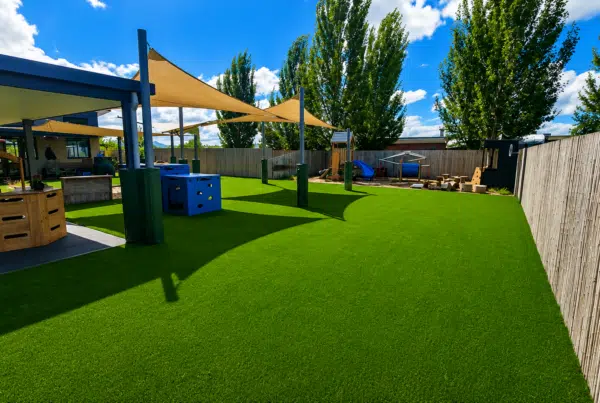
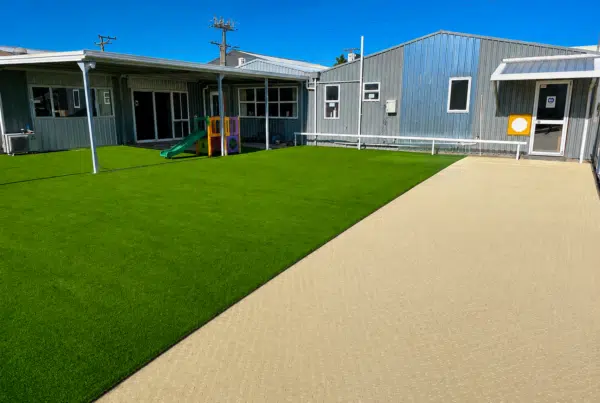
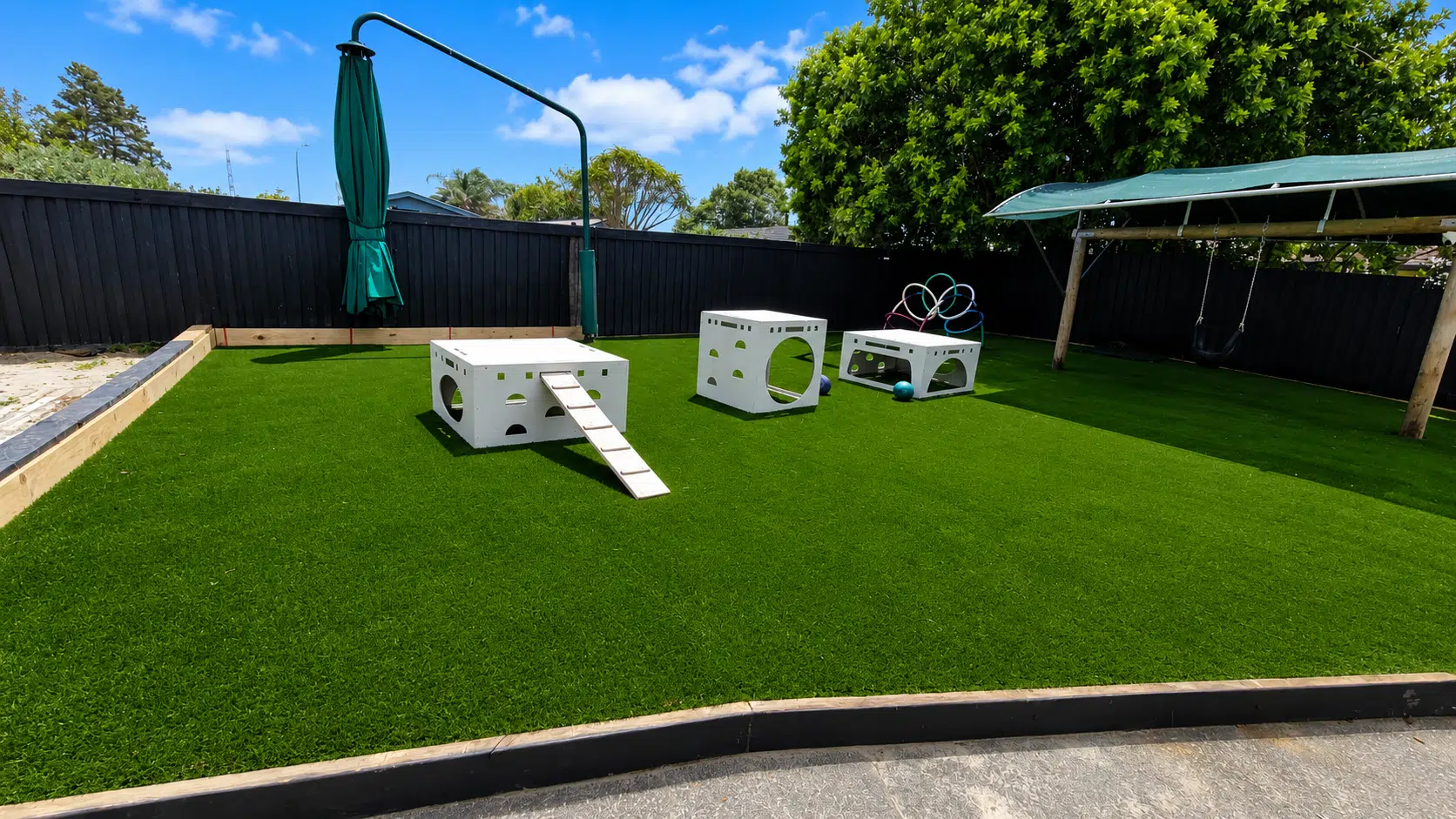
Artificial grass has become one of the fastest-growing playground surfacing choices for childcare centres throughout New Zealand. Designed for high-use environments, modern artificial grass provides a clean, durable and attractive surface that remains green throughout the year without the ongoing maintenance required by natural materials.
Unlike bark, artificial grass doesn’t need regular topping up, raking or replacement due to decomposition. When installed over a properly prepared base, it offers excellent drainage, helping outdoor play areas recover quickly after rain while reducing mud tracked into classrooms.
For playground equipment requiring impact protection, artificial grass can be installed over the SafeBase Certified Shockpad System to provide certified Critical Fall Height (CFH) protection for qualifying playground equipment. This allows childcare centres to create a safer outdoor environment while maintaining the natural appearance of a grassed playground.
Advantages of Artificial Grass
Artificial grass offers a range of benefits that make it well suited to busy childcare environments.
- Green and attractive throughout every season.
- Excellent drainage that helps reduce muddy play areas.
- Low ongoing maintenance with no mowing, watering or fertilising.
- Reduces mud, dirt and debris carried into classrooms.
- Suitable for heavy daily use without developing worn patches.
- Soft and comfortable underfoot for children.
- Can be installed with SafeBase where certified Critical Fall Height protection is required.
- Long-lasting and designed for high-traffic environments.
- Creates a clean, professional first impression for families visiting the centre.
Things to Consider
While artificial grass provides many long-term advantages, there are a few factors to consider before installation.
- Higher initial investment than bark.
- Professional installation is recommended to achieve the best long-term performance.
- An appropriate certified surfacing system is required beneath qualifying playground equipment where Critical Fall Height protection is needed.
- Product quality varies, making it important to choose a premium artificial grass designed for New Zealand conditions.
Why Many Childcare Centres Choose Unreal Lawns
Many childcare providers are looking beyond appearance when selecting a playground surface. They want a solution that improves safety, reduces maintenance and creates an outdoor environment children can enjoy throughout the year.
That’s why many centres choose Unreal Lawns’ exclusive Cool Turf 5-in-1 Technology. Designed specifically for New Zealand conditions, it delivers more than just a realistic-looking lawn. Combined with the SafeBase Certified Shockpad System, it provides excellent drainage, a surface designed to stay more comfortable during warmer months and the durability needed for busy childcare environments.
With different SafeBase configurations available to suit specific Critical Fall Height requirements, Unreal Lawns can provide certified impact protection for qualifying playground equipment while maintaining the natural appearance of artificial grass. The result is a cleaner, safer and lower-maintenance playground that supports outdoor learning throughout the year.
Transition
Both bark and artificial grass can provide safe playground surfacing when installed correctly. The biggest differences become clear when you compare how each surface performs in the day-to-day operation of a busy childcare centre. From maintenance and drainage to cleanliness and long-term costs, understanding these practical differences makes it much easier to choose the right solution.
Artificial Grass vs Bark: Head-to-Head Comparison
Both bark and artificial grass can provide safe playground surfacing when used appropriately, but they perform very differently in the day-to-day operation of a busy childcare centre. Comparing each surface across the factors that matter most helps identify which option best suits your centre’s needs.

Playground Safety
Safety is the highest priority when selecting any childcare playground surface.
Bark can provide effective impact attenuation beneath playground equipment when installed at the correct depth and maintained regularly. However, daily play naturally causes bark to move away from high-impact areas, making routine raking and topping up essential to maintain consistent protection.
Artificial grass installed over the SafeBase Certified Shockpad System can provide certified Critical Fall Height (CFH) protection for qualifying playground equipment. Because the shockpad remains fixed beneath the artificial grass, impact protection does not rely on continual redistribution in the way loose-fill bark does.
Winner: Artificial Grass ✓
Maintenance
One of the biggest differences between bark and artificial grass is the amount of ongoing maintenance required.
Bark requires regular raking to maintain an even surface, frequent topping up as the material breaks down and periodic replacement over time. These maintenance tasks become increasingly demanding in busy childcare centres where hundreds of children use the playground every week.
Artificial grass requires very little routine maintenance. Occasional cleaning and inspections are generally all that’s needed to keep the surface looking its best, allowing staff to spend less time maintaining playgrounds and more time supporting children.
Winner: Artificial Grass ✓
Drainage
Good drainage keeps playgrounds usable and reduces muddy conditions after rain.
Bark allows water to drain through the surface, but it can become saturated during prolonged wet weather, creating damp areas that are slower to dry.
Artificial grass is installed over a free-draining base that allows rainwater to pass through efficiently. This helps playgrounds recover more quickly after heavy rain, allowing children to return to outdoor play sooner.
Winner: Artificial Grass ✓
Cleanliness
Clean outdoor environments benefit both children and staff.
Bark is easily displaced during play and often becomes trapped in shoes, clothing and equipment before being carried into classrooms. Leaves, twigs and other organic material can also accumulate within bark, requiring regular cleaning.
Artificial grass creates a cleaner play environment by reducing loose material underfoot. Without bark being tracked indoors, classrooms generally stay cleaner, reducing cleaning time and helping maintain a tidier learning environment.
Winner: Artificial Grass ✓
Appearance
First impressions matter, particularly for families visiting a childcare centre for the first time.
Fresh bark provides a natural appearance that complements outdoor play spaces, but its appearance gradually changes as it breaks down and becomes uneven.
Artificial grass maintains a neat, green appearance throughout the year without developing worn patches, making outdoor areas look well cared for in every season.
Winner: Artificial Grass ✓
Long-Term Costs
Bark often has a lower upfront installation cost, making it an attractive option for centres working within a limited budget.
However, the ongoing costs of topping up, replacing bark and the staff time required for continual maintenance can add up over the life of the playground.
Artificial grass generally requires a higher initial investment, but its lower maintenance requirements and long service life often provide better long-term value for childcare centres planning to stay in their premises for many years.
Winner: Artificial Grass ✓
At a Glance
| Feature | Artificial Grass | Bark |
|---|---|---|
| Playground Safety | ⭐⭐⭐⭐⭐ | ⭐⭐⭐⭐☆ |
| Maintenance | ⭐⭐⭐⭐⭐ | ⭐⭐☆☆☆ |
| Drainage | ⭐⭐⭐⭐⭐ | ⭐⭐⭐☆☆ |
| Cleanliness | ⭐⭐⭐⭐⭐ | ⭐⭐☆☆☆ |
| Appearance | ⭐⭐⭐⭐⭐ | ⭐⭐⭐☆☆ |
| Long-Term Value | ⭐⭐⭐⭐⭐ | ⭐⭐⭐☆☆ |
Overall Verdict
Bark continues to be a suitable playground surface for some childcare centres, particularly where keeping initial installation costs low is the primary objective and regular maintenance can be managed.
However, for busy childcare environments, artificial grass offers significant advantages. It provides a cleaner, lower-maintenance playground, excellent drainage, a consistently attractive appearance and, when installed with the appropriate SafeBase system, certified Critical Fall Height protection for qualifying playground equipment.
For many childcare providers, the combination of improved usability, reduced maintenance and long-term value makes artificial grass the preferred choice for modern outdoor learning environments.
Artificial Grass vs Bark: Which Offers Better Long-Term Value?
When comparing playground surfacing, it’s easy to focus on the initial installation cost. However, the purchase price is only one part of the overall investment. Ongoing maintenance, repairs, replacement and the lifespan of the surface all contribute to the total cost of ownership.
For childcare centres planning to remain in their current location for many years, considering long-term value often provides a better basis for decision-making than installation cost alone.
Upfront Installation Costs
Bark generally has a lower initial installation cost, making it an attractive option for centres with limited budgets or those needing a quick playground upgrade.
Artificial grass typically requires a higher upfront investment because it includes site preparation, a professionally constructed base and the artificial grass itself. Where playground equipment requires Critical Fall Height (CFH) protection, the appropriate SafeBase configuration may also be incorporated into the installation.
While the initial investment is higher, many childcare providers view it as a long-term improvement rather than a short-term expense.
Ongoing Maintenance Costs
One of the biggest financial differences between bark and artificial grass is the ongoing maintenance required to keep the playground safe, tidy and functional.
Bark requires regular attention, including:
- Raking to maintain an even surface.
- Topping up bark as it settles and decomposes.
- Replacing bark periodically.
- Removing leaves and debris.
- Repairing areas where bark has been displaced.
Artificial grass requires significantly less routine maintenance. Occasional cleaning, brushing in high-traffic areas and periodic inspections are generally all that’s needed to keep the surface performing well.
For many childcare centres, the reduction in maintenance saves both time and ongoing operating costs.

Lifespan
Because bark is an organic material, it naturally breaks down over time and requires continual replenishment.
Premium artificial grass is designed for heavy daily use and, when professionally installed over a properly prepared base, can provide many years of reliable performance. This longer lifespan helps spread the initial investment over a much longer period.
Value Beyond Cost
The true value of a playground surface isn’t measured by installation cost alone.
Many childcare providers also consider the wider benefits, including:
- Cleaner classrooms with less mud and debris.
- More usable outdoor play days after rain.
- Reduced time spent maintaining playgrounds.
- A more attractive environment for visiting families.
- Greater confidence in the long-term durability of the playground.
These practical benefits often have a positive impact on the daily operation of the childcare centre, making them an important part of the overall value equation.
Which Surface Delivers Better Value?
If the primary objective is to minimise upfront installation costs, bark may be the preferred option.
However, for childcare centres looking for a long-term playground solution, artificial grass often delivers better overall value. Lower maintenance requirements, excellent drainage, year-round usability and a longer service life can help offset the higher initial investment while creating a cleaner, safer and more enjoyable outdoor environment for children.
Transition
Cost is only one part of choosing the right playground surface. Every childcare centre has different priorities, from playground safety and maintenance to budget and outdoor learning goals. Before making a final decision, it’s worth considering which surface best supports the way your playground is used every day.
Which Playground Surface Is Right for Your Childcare Centre?
There is no single playground surface that is perfect for every childcare centre. The right choice depends on your budget, the type of playground equipment, the amount of daily use and how much time you want to spend maintaining your outdoor areas.
Bark continues to be a practical option for some childcare centres, particularly where keeping upfront costs low is the main priority and staff are able to commit to regular maintenance. When maintained correctly, it can provide suitable impact attenuation beneath playground equipment and continues to be used in many playgrounds throughout New Zealand.
However, many childcare providers are now choosing artificial grass because it offers benefits that extend well beyond appearance. Cleaner outdoor play areas, excellent drainage, reduced maintenance and year-round usability all contribute to a more practical learning environment for children and staff.
When installed over the appropriate SafeBase Certified Shockpad System, artificial grass can also provide certified Critical Fall Height (CFH) protection for qualifying playground equipment. This allows childcare centres to combine playground safety with a clean, natural-looking surface that performs consistently throughout the year.


Artificial Grass May Be the Better Choice If You Want To:
- Reduce mud and dirt tracked into classrooms.
- Minimise ongoing playground maintenance.
- Keep outdoor play areas usable after rain.
- Create a tidy, professional first impression for families.
- Install a surface designed for heavy daily use.
- Incorporate certified playground safety beneath qualifying equipment.
- Invest in a long-term playground solution that delivers lasting value.
Bark May Still Be Suitable If You:
- Have a limited installation budget.
- Are surfacing a small playground area.
- Can commit to regular raking and topping up.
- Prefer a natural loose-fill playground surface.
- Don’t mind periodic replacement as the material breaks down over time.
Why More Childcare Centres Are Choosing Unreal Lawns
At Unreal Lawns, we understand that every childcare playground is different. That’s why we take the time to assess how your outdoor space is used before recommending the most suitable surfacing solution.
Our premium artificial grass systems are designed for New Zealand conditions and can be installed with the SafeBase Certified Shockpad System where certified Critical Fall Height protection is required.
Combined with our exclusive Cool Turf 5-in-1 Technology, excellent drainage and professional installation, our playground systems help create cleaner, safer and lower-maintenance outdoor environments that children can enjoy throughout the year.
Whether you’re upgrading an existing playground or planning a brand-new outdoor learning space, our experienced team can help you choose a solution that balances safety, durability, appearance and long-term value.
About the Author: Paul Gardner
Founder & Global Turf Specialist at Unreal Lawns
Paul Gardner has spent years developing his knowledge of synthetic turf technology, including travelling internationally to study manufacturing, yarn engineering and playground safety systems. His experience helps shape the artificial grass and playground surfacing systems Unreal Lawns provides for New Zealand conditions.
Learn More About Artificial Grass for Childcare Centres
Choosing the right playground surface is just one part of creating a safe, practical and enjoyable outdoor learning environment. Explore our related guides, products and technologies to learn more about playground safety, surfacing options and choosing the right artificial grass system for your childcare centre.
Childcare Guides
- Childcare Playground Surfacing – Learn how to choose the right playground surface for your childcare centre, including artificial grass, bark, wet pour rubber and natural grass.
- Playground Safety Standards for Childcare Centres – Learn about Critical Fall Height (CFH), recognised playground safety standards, certified surfacing systems and how to create safer outdoor play environments.
- Artificial Grass Cost for Childcare Centres – Understand the factors that influence artificial grass installation costs and how to compare quotations with confidence.
- Artificial Grass Maintenance for Childcare Centres – Discover simple maintenance practices that keep artificial grass playgrounds clean, safe and performing at their best throughout the year.
Playground Safety & Technology
- SafeBase Certified Shockpad System – Discover our independently tested playground impact protection system, certified to NZS 5828:2015 and EN 1177:2018 and designed for use beneath premium artificial grass where Critical Fall Height protection is required.
- Cool Turf 5-in-1 Technology – Discover how our exclusive artificial grass technology enhances comfort, durability and long-term playground performance.
- Professional Artificial Grass Installation – Find out why expert site preparation, drainage and installation are essential for long-lasting playground performance.
Childcare Solutions
- Artificial Grass for Childcare Centres – Explore our complete range of artificial grass solutions designed for childcare centres, outdoor learning spaces and playgrounds throughout New Zealand.
Frequently Asked Questions
Is artificial grass better than bark for childcare centres?
Both playground surfaces have their advantages, but many childcare centres now choose artificial grass because it offers lower maintenance, better drainage, a cleaner play environment and year-round usability. When installed with the appropriate SafeBase Certified Shockpad System, it can also provide certified Critical Fall Height (CFH) protection for qualifying playground equipment.
Is bark still a good playground surface?
Yes. Bark remains a suitable playground surface, particularly beneath play equipment where impact attenuation is required. However, it requires regular raking, topping up and replacement to maintain its depth, appearance and safety performance.
Does artificial grass need a certified shockpad?
Not always. A certified impact-attenuating surfacing system is generally required beneath qualifying playground equipment where Critical Fall Height (CFH) protection is needed. In these areas, the appropriate SafeBase Certified Shockpad System can be installed beneath the artificial grass to provide the required certified impact protection. Open play areas, outdoor learning spaces and other areas without a CFH requirement may not require a shockpad.
What is Critical Fall Height (CFH)?
Critical Fall Height (CFH) is the maximum height from which a child can fall while reducing the risk of serious head injury. Playground surfacing beneath qualifying equipment should be independently tested and certified to provide the appropriate level of impact attenuation for the equipment being installed.
Which playground surface requires less maintenance?
Artificial grass requires significantly less maintenance than bark. It doesn’t need regular raking, topping up or replacement and helps reduce the amount of mud and debris carried into classrooms. Occasional cleaning and inspections are generally all that’s required.
Which playground surface lasts longer?
Premium artificial grass typically has a much longer lifespan than bark when professionally installed over a properly prepared base. Bark naturally decomposes over time and requires regular replenishment to maintain its performance and appearance.
Does artificial grass improve playground drainage?
Yes. Artificial grass is installed over a free-draining base that allows rainwater to pass through efficiently. This helps reduce puddles and muddy areas, allowing children to return to outdoor play sooner after wet weather.
Which playground surface is cleaner for childcare centres?
Artificial grass generally creates a cleaner outdoor environment because there is no loose material to be carried indoors. Unlike bark, it doesn’t track into classrooms on children’s shoes and helps reduce mud and debris throughout the centre.
Is artificial grass more expensive than bark?
Artificial grass usually has a higher upfront installation cost than bark. However, many childcare centres find it provides better long-term value through lower maintenance, reduced replacement costs, improved durability and year-round usability.
How do I choose between bark and artificial grass?
The best choice depends on your playground equipment, maintenance expectations, budget and long-term goals. Bark can be a practical option where lower upfront costs are the priority, while artificial grass is often preferred by childcare centres looking for a cleaner, lower-maintenance and longer-lasting playground surface that supports safe outdoor play throughout the year.
Can artificial grass replace an existing bark playground?
Yes. Many childcare centres replace existing bark playgrounds with artificial grass as part of a playground upgrade. The existing bark is removed, a professionally prepared free-draining base is installed and, where Critical Fall Height protection is required, the appropriate SafeBase Certified Shockpad System can be installed beneath the artificial grass. This creates a cleaner, lower-maintenance playground while providing certified impact protection for qualifying play equipment where required.
Need Help Deciding?
Every childcare centre has unique requirements, and choosing the right playground surface is an important long-term decision.
If you’re weighing up bark and artificial grass, we’re happy to provide practical advice based on your playground layout, equipment, safety requirements and budget. Our team can explain the options, recommend the most suitable surfacing system and help you create an outdoor environment that supports safe, active play for years to come.